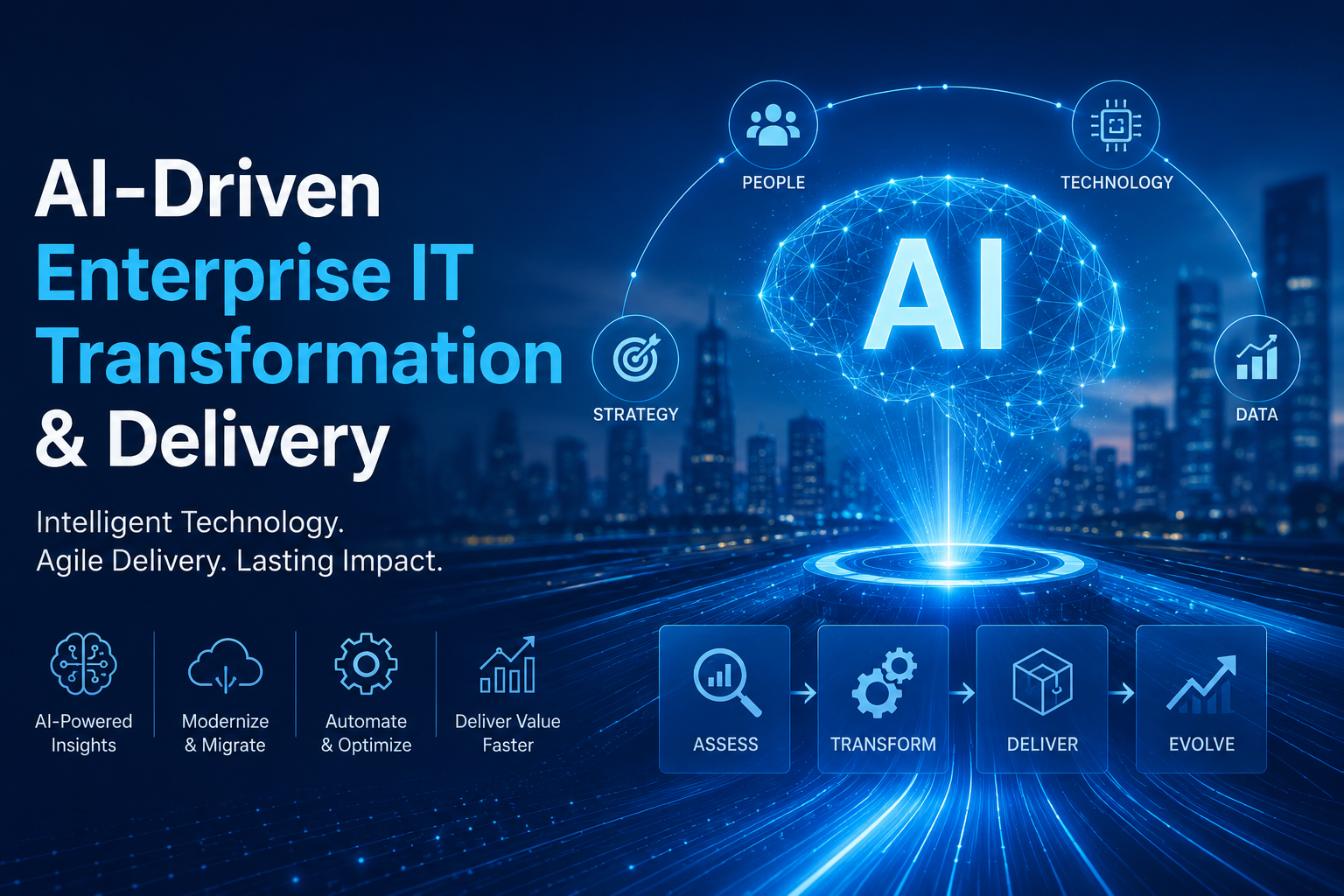
AI-driven enterprise IT transformation uses machine learning, automation, and intelligent orchestration to accelerate, de-risk, and optimize how large organizations deploy, run, and support enterprise applications — replacing manual, slow, error-prone processes with adaptive, self-improving systems. AI mature implementation is typically 2–4x faster delivery cycles, 50–70% reduction in production incidents, and significant reduction in manual toil — free engineering capacity for higher-value work. The transformation is iterative, not a big bang: start with observability and AIOps, then extend AI into the delivery pipeline, then into planning and support. Let’s see how AI transforms Enterprise Applications in various phases:
1. Planning & Requirements
-
AI-assisted scoping: NLP models parse business requirements, flag ambiguities, and auto-generate user stories or acceptance criteria.
- Enterprise programs receive requirements from multiple stakeholders in multiple formats Word docs, Jira stories, Confluence pages, and PDF policy documents. Synthesizing all of this manually is slow and error prone. NLP resolved it following steps in fraction of time:
- Text Extraction & Normalization
- Named Entity Recognition (NER) with Identifies: Systems, Actors, Business Processes, Data Objects, Rules, Constraints
- Semantic Chunking with grouping into coherent requirement units
- Structured Requirements Output (User stories, Acceptance Criteria, Business Rules, Data Definitions)
- Example:
Raw BRD Text Input: "The finance team needs to be able to generate monthly consolidated P&L reports across all subsidiaries before the 5th working day of each month. Reports must comply with IFRS 15 and be exportable to Excel and PDF."
NLP Extracts & Structures:
Actor: Finance Team
Function: Generate consolidated P&L reports
Scope: All subsidiaries
Constraint: Before 5th working day of each month
Compliance: IFRS 15
Output: Excel, PDF export
Priority: High (time-bound, compliance-linked)
Auto-Generated User Story:
"As a Finance Team member, I want to generate consolidated P&L reports across all subsidiaries so that I can meet IFRS 15 reporting obligations by the 5th working day of each month."
Acceptance Criteria (AI-generated):
- Report aggregates data from all subsidiary entities
- Consolidation eliminates intercompany transactions
- Report is available by EOD of 5th working day
- Export to .xlsx and .pdf formats is supported
- Report includes IFRS 15 revenue recognition breakdown
- Enterprise programs receive requirements from multiple stakeholders in multiple formats Word docs, Jira stories, Confluence pages, and PDF policy documents. Synthesizing all of this manually is slow and error prone. NLP resolved it following steps in fraction of time:
-
Ambiguity & Gap Detection: NLP models are trained to detect linguistic patterns that signal requirement quality problems and gaps. While checking completeness, NLP models compare the requirement set against a known template schema for that domain.
Example:
The Problem: Incomplete or contradictory requirements are the #1 cause of rework in enterprise programs. They are rarely caught until development is underway.
How NLP Solves It:
Ambiguity Classification NLP models are trained to detect linguistic patterns that signal requirement quality problems:
Ambiguity Type
Example
NLP Flag
Vague quantifiers
"system should be fast"
Missing SLA — define response time
Passive voice with missing actor
"data should be validated"
Who validates? When?
Undefined pronouns
"it should sync with the system"
Which system?
Missing error handling
"user submits the form"
What happens on failure?
Conflicting statements
Two reqs specifying different tax logic
Contradiction detected
Missing negative scenarios
Only happy path described
Edge cases not defined
Completeness Checking: NLP models compare the requirement set against a known template schema for that domain:
Domain: Order-to-Cash (SAP SD)
Expected Requirement Categories:
- ✅ Order creation flow — Found (12 requirements)
- ✅ Pricing and discounts — Found (8 requirements)
- ⚠️ Credit limit checking — Partially covered (2 of 7 expected)
- ❌ Returns and reversals — NOT FOUND
- ❌ Revenue recognition — NOT FOUND
- ⚠️ Integration with finance — Partially covered
Report: 23% of expected O2C requirements are missing
Recommended: Schedule requirements workshop on Returns/Reversals and Revenue Recognition
- Effort estimation: ML models trained on historical project data predict timelines, resource needs, and risk hotspots before a line of code is written. Traditionally Story points estimated by gut feel, T-shirt sizing, or planning poker — highly subjective, wildly variable. ML models (typically gradient boosted trees or neural networks) are trained on historical project data, compliant with Management practices, comes with Effort estimate (story points or days, with confidence interval), Risk score (Low / Medium / High / Critical), Similar historical requirements (with actual vs. estimated hours), Key risk factors driving the estimate.
-
Requirement Traceability & Dependency mapping: Graph-based AI identifies hidden cross-system dependencies that humans miss in complex ERP/CRM landscapes. NLP extracts entities and relationships from requirements. A graph ML model then builds a requirement dependency graph with Impact Analysis. This replaces weeks of manual impact analysis workshops with an automated, real-time dependency map.
NLP extracts entities and relationships from requirements. A graph ML model then builds a requirement dependency graph showing:
- Which requirements share the same data objects
- Which downstream systems are affected
- Which requirements are prerequisites for others
- Which requirements conflict with each other
Requirement Graph (Simplified):
REQ-001 (Customer Master Data)
    │
    ├──► REQ-045 (Order Management) ──► REQ-089 (Invoice Generation)
    │                                        │
    ├──► REQ-067 (Credit Checking)           └──► REQ-112 (Revenue Recognition)
    │
    └──► REQ-033 (Delivery Processing)
Impact Analysis:
If REQ-001 changes (Customer Master Data structure),
AI flags: REQ-045, REQ-067, REQ-033, REQ-089, REQ-112 all require re-evaluation
This replaces weeks of manual impact analysis workshops with an automated, real-time dependency map.
- Prioritization Intelligence: ML models help product owners prioritize the backlog by scoring requirements against multiple dimensions simultaneously with prioritization Scores and weightages (Urgency/Risk/Dependency/Cost of Delay)
2. Development & Integration
-
Copilot-assisted coding: Reduces boilerplate and accelerates API integration (SAP, Salesforce, ServiceNow, etc.).
-
Automated test generation: AI writes regression and integration tests from specs or existing behavior, increasing coverage without human cost.
-
Configuration drift detection: Models flag when environment configs diverge from baseline, catching deployment failures before they happen.
3. Deployment & Release
-
Intelligent CI/CD pipelines: AI gates releases based on test confidence scores, code churn, and historical defect patterns — not just pass/fail.
-
Traditional CI/CD pipelines are rule-based: if tests pass, deploy. If coverage threshold met, proceed. These rules are static and treat all changes as equal. ML makes pipelines risk-aware and adaptive — every decision is weighted by historical patterns, real-time signals, and predicted outcomes.
Full test suites take hours. Running everything on every commit slows developer feedback loops to a crawl and burns CI infrastructure costs. ML Solution is Predictive Test Selection. On every commit, ML model analyzes: Code Change Signals and Historical Correlation Data and provides output with MUST RUN (high-risk, directly covering changed code), RECOMMENDED RUN (correlated historically) and SKIP (no historical correlation, no coverage overlap).
ML replaces static quality gates with dynamic, context-aware gates.
Before every deployment, an ML model produces a deployment risk score — a composite signal that determines how the release proceeds. With input on Code Change Signals, Historical Signals and Temporal/Contextual Signals ML model produces Risk Score, Deployment Strategy Recommendation and Key Risk Factors:
-
Canary/blue-green automation: AI decides rollout pace based on real-time error rates, latency signals, and business-hour risk windows. ML doesn't just recommend canary deployments — it actively manages the rollout in real time.
-
Infrastructure right-sizing: ML continuously adjusts compute/memory allocation based on actual load patterns, cutting cloud spend.
4. Performance Optimization
ML continuously analyzes pipeline performance and recommends structural improvements.
-
AIOps platforms (Dynatrace, Datadog AI, New Relic): correlate thousands of metrics/logs/traces to pinpoint root causes in minutes vs. hours.
-
Predictive scaling: Forecast load spikes (month-end, promotions) and pre-provision resources before degradation occurs.
-
Query & cache optimization: AI analyzes slow query patterns and recommends or auto-applies index changes, cache warming strategies.
-
Feedback Loop — Closing the CI/CD Intelligence Cycle: This is what makes the system truly ML-powered rather than just automated. Every deployment outcome feeds back into the models with Deployment Outcome Data. This data continuously retrains, resulting in making the pipeline measurably smarter with every deployment cycle
5. End-to-End Intelligence Flow
REQUIREMENTS PHASE
NLP parses BRDs → Structures user stories
NLP detects gaps/ambiguities → Flags for resolution
Graph ML maps dependencies → Informs sprint planning
ML estimates effort → With confidence intervals
SPRINT PLANNING
ML scores and prioritizes backlog
Risk-adjusted capacity planning
DEVELOPMENT
AI copilot assists coding
NLP generates test cases from acceptance criteria
CI PIPELINE
ML selects relevant tests → Fast feedback
AI quality gates → Risk-adjusted thresholds
Static analysis + CVE scanning → AI-prioritized
DEPLOYMENT
ML risk scoring → Strategy recommendation
Progressive delivery → ML-managed rollout
Real-time anomaly detection → Auto-rollback
PRODUCTION
AIOps monitors → Feeds outcomes back
Incident data → Retrains all upstream models -> Continuous Learning Loop
6. Support & Operations
-
Incident triage: AI classifies, routes, and suggests fixes for incidents automatically, reducing MTTR by 40–70% in mature implementations.
-
Self-healing systems: Automated runbooks trigger on anomaly detection — restart services, flush caches, reroute traffic — without human intervention.
-
Predictive maintenance: Models flag components likely to fail before they do, shifting from reactive to proactive support.
-
AI-powered service desks: LLM-backed agents handle L1/L2 tickets (password resets, access provisioning, how-to queries) at scale.
Key Improvement Areas
|
Domain |
Traditional |
AI-Driven |
|
Deployment frequency |
Quarterly/monthly |
Daily/on-demand |
|
Incident MTTR |
Hours to days |
Minutes |
|
Test coverage |
40–60% manual |
80–90%+ automated |
|
Capacity planning |
Spreadsheet-based |
ML-forecast, automated |
|
Root cause analysis |
War room, 2–4 hrs |
Correlated, <15 min |
|
Change failure rate |
15–30% |
5–10% |
Enterprise Patterns That Work Well
-
Platform engineering + AI: Internal developer platforms with AI-embedded guardrails reduce cognitive load and standardize delivery.
-
FinOps + AI: Continuous cost anomaly detection prevents cloud bill surprises at scale.
-
DataOps integration: AI pipelines feed clean, governed data into enterprise apps (ERP analytics, supply chain AI) rather than treating data as an afterthought.
-
Observability-first: Full-stack observability (traces, metrics, logs, user sessions) is the prerequisite — AI needs signal quality to be effective.
Key Enablers for Success
-
Clean, accessible data — AI is only as good as the telemetry and historical data feeding it.
-
Platform standardization — AI tooling works best across a consistent, well-defined tech stack.
-
Human-in-the-loop governance — Especially for high-risk changes; AI recommends, humans approve.
-
Feedback loops — Every deployment outcome, incident, and user report should feed back into model training.
-
Change management — The biggest blocker is organizational, not technical; teams need to trust and adopt AI-generated recommendations.
The net result for mature implementations is typically 2–4x faster delivery cycles, 50–70% reduction in production incidents, and significant reduction in manual toil — freeing engineering capacity for higher-value work. The transformation is iterative, not a big bang: start with observability and AIOps, then extend AI into the delivery pipeline, then into planning and support.
Talk to us at the link below: